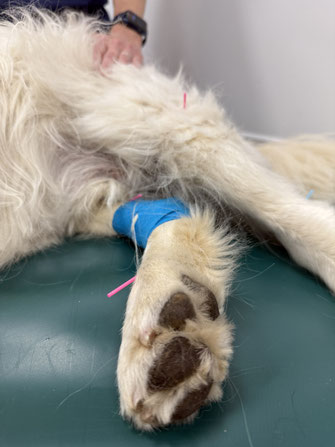
Hock / Ankle Laxity in Dogs

What is it?
Bilateral ankle (hock) laxity or instability in a dog is a serious orthopeadic condition where the ligaments that stabilize the hock joint on both hind legs are damaged, weakened, or deformed. This condition is often characterised by the joint appearing to sink, twist, or bend abnormally under weight. While it can be caused by severe trauma, it is also seen as a developmental issue in young dogs or a degenerative condition in older dogs.
Potential Causes
- Traumatic Injury: The most common cause is a traumatic event (e.g., fall, road accident, jumping) causing severe tears to the medial or lateral collateral ligaments of the hock.
- Developmental/Ligamentous Laxity: Young, large-breed dogs can suffer from developmental laxity where ligaments are not strong enough to support the growing body, sometimes causing the joint to sink.
- Chronic Degeneration: In older dogs, chronic weakening of the ligaments (potentially related to obesity, abnormal conformation, or excessive exercise) can lead to gradual, progressive laxity.
- Compensation for Other Injuries: If a dog has knee (stifle) issues like a CCL rupture, they may develop chronic ankle instability due to compensation.
Symptoms
- Abnormal Posture: The hock joint may appear straight, "down," or "droopy," with the dog bearing weight on the lower part of the leg.
- Abnormal Gait: The dog may walk with a "bear-like" or rolling gait.
- Lameness: Lameness may be sudden and severe if caused by trauma, or subtle, intermittent, and chronic if caused by degradation.
- Pain and Swelling: Heat, swelling, and pain around the joint, particularly in acute injuries.
- Instability: The hock joint can be seen to bend in the opposite direction or twist inwards/outwards (valgus or varus deformity).
Diagnosis
Veterinarians diagnose this condition through:
- Physical Exam: Testing the hock by trying to open the joint from the outside and inside with the hock in both extension and flexion.
- Stress Radiographs (X-rays): Taken under sedation, these reveal the extent of the ligament damage, allowing the veterinarian to see the instability.
- CT Scanning: Sometimes needed for a more detailed look at the damage within the joint.
Treatment and Management
Treatment for true, full-joint instability or severe ligamentous laxity usually requires veterinary intervention rather than conservative management alone.
- Surgery (Arthrodesis): In cases of severe trauma or structural failure, the most common and often best outcome is achieved through pantarsal or partial arthrodesis (fusing the joint).
- Surgical Repair: If it is a ligament rupture (without major fracture), screws may be placed in the bones above and below the joint to simulate the ligament with heavy suture.
- External Coaptation (Splinting): A splint or cast can be used to manage injuries and allow the joint to stabilise with scar tissue, often used for moderate cases or as part of post-operative care.
- Orthotics/Braces: A custom hock brace (tarsal orthosis) can be used to manage chronic, non-surgical cases.
- Physical Therapy: Mandatory for rehabilitation to manage pain and improve mobility.
Note: Prognosis varies based on the cause. Surgical repair often has a high success rate, but there is a risk of ongoing lameness or arthritis if not managed appropriately.
Ripley's Experience:
Seen by: James Grierson (BVetMed CertVR CertSAS DipECVS FRCVS)
@ Anderson Moores Veterinary Specialists
Diagnosis: Bi-Lateral Ankle Laxity
Likely reason for occurrence - compensation after CCL (TPLO surgeries)
Hock support:
Balto Hock Brace
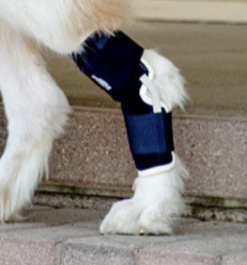
Taping

NMES
NMES (NeuroMuscular Electrical Stimulation) and related electrotherapies for dogs are safe, low-risk rehabilitation techniques that use low-level electrical currents to stimulate muscles and nerves. Used to treat muscle atrophy, reduce pain from injury or surgery, and improve joint stability, these therapies are highly effective for injured or senior dogs needing to rebuild strength.
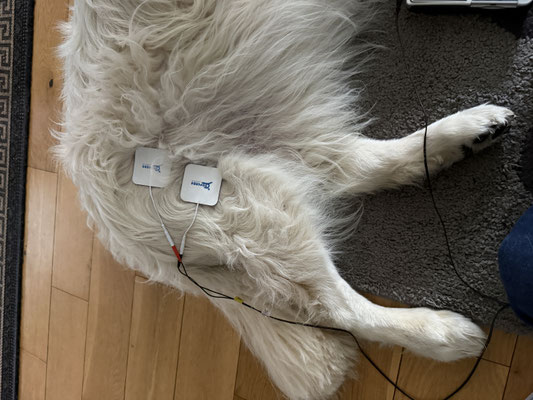
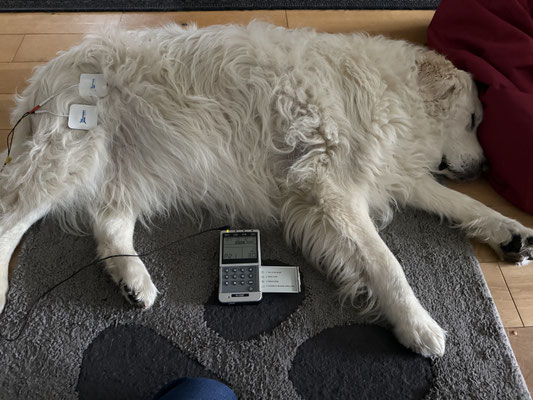
Treatment:
Osteopathy
Hydrotherapy
Acupuncture