
Travelling from UK to Europe with your dog

Animal Health Certificate:
In order for a Vet to issue an AHC, your dog must have:
- Microchip
- Rabies Vaccine (Min: 21 days before AHC)
- Tapeworm Treatment (between 24-120hours before travel) applicable if travelling to Finland, Ireland, Malta, Northern Ireland or Norway)
- The country of entry into E.U. (i.e. France)
- AHC must have been completed less than 10 days before you leave the U.K.
Returning to U.K.
Within 24 - 120 hours (5 days):
- Tapeworm treatment by registered vet & recorded on AHC. Must contain praziquantel or an equivalent proven to be effective against the Echinococcus multilocularis tapeworm.
Information the vet needs to record on the AHC
Check the vet has put the following details in the ‘Echinococcus treatment’ section of your dog’s pet passport or health certificate:
- the name and manufacturer of the product
- the date and time they treated your dog
- their stamp and signature
Can I take my Dog's own food when travelling from UK to Europe?
You generally cannot take dog food containing meat or dairy from the UK into the EU due to post-Brexit restrictions. Such items will likely be confiscated at the border. Exceptions exist for specialised pet food required for medical reasons (up to 2kg), or vegan/plant-based food.
Can I take my dog's prescription medication when travelling from the UK to Europe?
Yes, you can take dog medication from the UK to the EU, but there are specific rules and restrictions you must follow, particularly regarding documentation and the type of medication.
Prescription and Medication Rules
- Proof of Prescription: It is highly advisable to carry the original prescription for any medication, especially if it is a controlled substance, to prove it is for your dog and not for resale.
- Keep in Original Packaging: Keep all medication in its original, labelled packaging from the veterinarian.
- Quantity: Only take an amount necessary for your trip. Taking large quantities may raise suspicion with customs.
- Specific Restrictions: If your dog takes controlled medication, check the rules of the specific country you are entering, as some EU countries have strict regulations.
It is strongly advised to check the specific requirements for your destination country's embassy or the UK government website (gov.uk) before traveling.
Travelling by Eurotunnel to Europe with a dog:
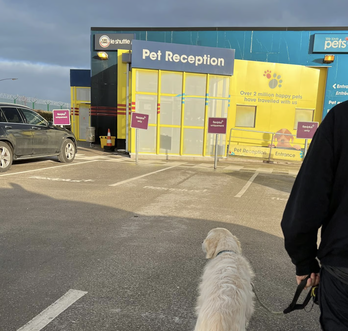
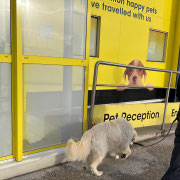
In a nutshell: Pre-book your dog. Go to Pet Reception to 'check-in' where microchip will be scanned and AHC document checked.
Key Informatiion for Traveling with a Dog:
- Booking: You must add your pet to your booking in advance.
- Pet Reception: Upon arrival, you must visit the designated Pet Reception area (follow the paw prints) to check your dog’s documents and microchip.
- Check-in Time: Arrive 1 to 2 hours before your departure to complete the pet checks.
Documents Needed:
- Microchip: A functioning microchip is mandatory.
- Rabies Vaccination: Must be up-to-date.
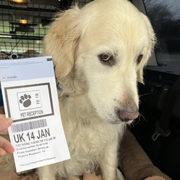
- Document: An EU Pet Passport (if issued in the EU) or an Animal Health Certificate (AHC) for UK-issued, required for each trip.
- Tapeworm Treatment (UK bound only): Dogs entering the UK must have a tapeworm treatment administered by a vet 24 hours to 5 days before arrival.
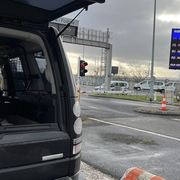
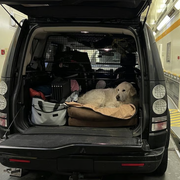
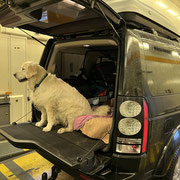
On the Train: Dogs stay inside your vehicle for the duration of the 35-minute crossing.
Facilities: Both terminals (Folkestone and Calais) have dedicated, air-conditioned Pet Reception areas and exercise areas.



Travelling by Ferry to Europe with a Dog:
Examples of Ferry operators that allow dog travel:
- Brittany Ferries: Offers pet-friendly cabins, kennels, and car-stay options on routes like Portsmouth-Caen/St Malo/Cherbourg.
- P&O Ferries: Dover-Calais route with in-car or Pet Lounge options.
- DFDS: Dover-Calais, offers pet-friendly cabins.
- Stena Line: Offers kennels and some pet-friendly cabins.
Tips for Travel
- Book early, especially during peak times.
- Onboard, dogs must generally be muzzled and on a lead when outside the vehicle or cabin.
- Bring water, food, and familiar items for your dog's comfort.