
Dog Fusion Laser Podoplasty

What: Laser podoplasty is a surgical procedure for dogs that uses a CO2 laser to remove "false pad" tissue and interdigital cysts. It is often performed when these conditions cause chronic discomfort, typically healing through secondary intention (open healing) after the laser vaporises the targeted tissue.
Purpose: It is primarily used to treat false pad tissue (abnormal skin growth on the paw) and interdigital cysts, which can be caused by factors like atopic dermatitis or constant pressure on haired skin.
The Procedure: Performed under general anesthesia, the CO2 laser cuts and vaporises the unwanted tissue. Because the laser seals blood vessels and nerve endings as it cuts, it typically results in less bleeding, reduced pain, and less inflammation than traditional surgical excision.
Recovery: Stitches are rarely used. Wounds are often bandaged for a short period, then left to heal by "secondary intention" meaning they close naturally over the course of 3 to 4 weeks.
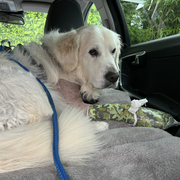
Ripley's experience
Fusion Laser Podoplasty (Right Paw)
20/10/2023
Diagnosis: Digital arthritis, conformational pododermatitis with pseudopad formation, intertrigo and interdigital trichlgranulomas.
Surgery: Laser podoplasty with ablation of the entirety of the palmar haired skin between the effected pads aswell as pseudopad.
Surgeon: Matteo Cantatore at: Anderson Moores
Post Op Meds: Antibiotics, 400mg Gabapentin 3 x per day, 500mg Paracetamol 3 x per day

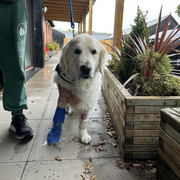
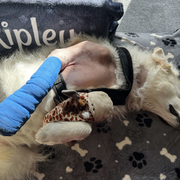
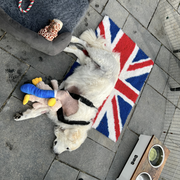

Post Surgery:
Post Fusion Laser Podoplasty Op Vet Check Up (Right)
23/10/2023
Wound cleaning & tractor bandaging # 1 by Vet Bobby Moseley & Nurse Georgia Butt at: Hillside Veterinary Centre, Dorset
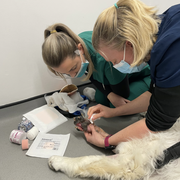

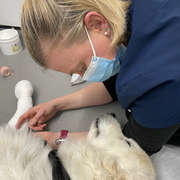

Post Fusion Laser Podoplasty Op Vet Check Up (Right)
25/10/2023
Wound cleaning & camo bandaging # 2 by Vet Bobby Moseley & Nurse Georgia Butt at: Hillside Veterinary Centre, Dorset
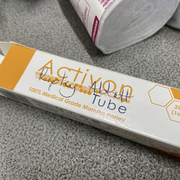
Application of 100% Medical Grade Manuka Honey - reduces bacterial load & helps prevent infection.
Manuka honey is widely used in veterinary medicine, particularly for wound care, due to its high methylglyoxal (MGO) content which provides antibacterial, anti-inflammatory, and antioxidant properties. It treats wounds, burns, and skin infections by reducing edema, debriding tissues, and promoting a moist healing environment
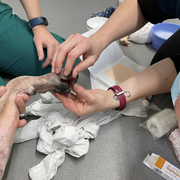
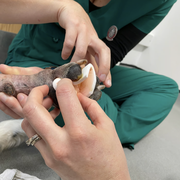
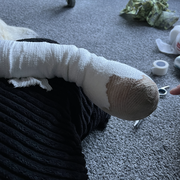
Post Fusion Laser Podoplasty Op Bandage Changing (at home)
26 & 27/10/2023
Wound cleaning & bandaging # 3 & 4 at home ! Due to the non-stop heavy rain, inevitable Ripley's camo bandage got wet today (even with plastic wrapping whilst out on his 5 min walk..) FYI the marking on the white bandage on the photo is NOT water but rather wound secretion !.. so it was the first experiences of 'at home' bandage changing. There is certainly a reason why paying a vet to do this is so important, as it is very stressful...
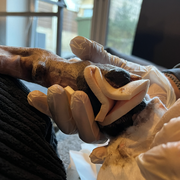
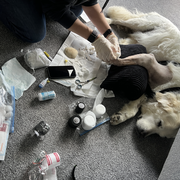
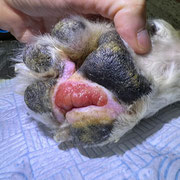
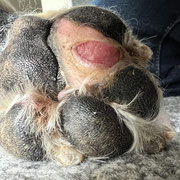
Prolonged Healing Issues
Hypergranulation tissue, or "proud flesh," is an excess growth of bright red, friable (easily bleeding) tissue that rises above the wound surface, stalling healing by creating a barrier to skin regeneration. Often caused by infection, friction, or excessive moisture.
Impact on Healing: It blocks keratinocytes (skin cells) from migrating across the wound, which stops or slows down re-epithelialisation.
Our solution: 'Magic cream' = hydrocortisone + Chloramphenicol 1% combination.
What we were told regarding application: Improvement noted in the granulation tissue, the cream can be used until the wound is fully epithelialised (covered with skin) provided you are not seeing any regression or signs of infection.
Red Light Therapy
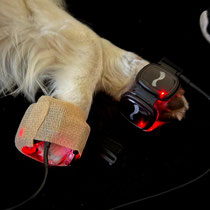
Wound/Surgical Healing: Accelerates recovery from injuries, surgical incisions, and hot spots.
- Safe for Pets: It is a non-thermal, non-toxic, and non-invasive therapy
How to Administer Red Light Therapy
- Device Types: Use devices designed specifically for pets, including handheld lasers or therapy wraps/mats.
- Treatment Length: Standard practice is 3–5 minutes per body part.
Long term post-op considerations:
Due to the way the paw heals post surgery the paw pads are NOT the same as pre-surgery - therefore for Ripley, for the rest of his life on walks (with the exception of soft grass) he was either in 'trainers' or we bandaged his paw. We do not regret the surgery as he was in pain prior but we want to make you aware that this may be the same situation for your dog. Its certainly no something we were forewarned of as being a possibility by either of the surgeons that carried out his paw surgeries....

Clinical Papers:
Pathogenesis of canine interdigital palmar and plantar comedones and follicular cysts, and their response to laser surgery
https://pubmed.ncbi.nlm.nih.gov/18477329/
Duclos DD, Hargis AM, Hanley PW. Pathogenesis of canine interdigital palmar and plantar comedones and follicular cysts, and their response to laser surgery. Vet Dermatol. 2008 Jun;19(3):134-41. doi: 10.1111/j.1365-3164.2008.00662.x. PMID: 18477329.
A retrospective case series of the postoperative outcome for 30 dogs with inflammatory interdigital nodules, surgically treated with carbon dioxide laser and a nonantimicrobial wound-healing protocol
https://pubmed.ncbi.nlm.nih.gov/36694420/
Frey R, Varjonen K. A retrospective case series of the postoperative outcome for 30 dogs with inflammatory interdigital nodules, surgically treated with carbon dioxide laser and a nonantimicrobial wound-healing protocol. Vet Dermatol. 2023 Apr;34(2):150-155. doi: 10.1111/vde.13146. Epub 2023 Jan 24. PMID: 36694420.